

I have taught an introductory level New Testament course in one form or another for most of my 20-year career in academics. I have taught it at the undergraduate, graduate and professional levels. I have taught it with and without textbooks, with research papers, essays, essay exams, and multiple choice exams. I have taught it from a theological perspective, from a historical perspective, and from a literary perspective. What I had not done is to teach it from a non-elite perspective. Until Spring 2023. I just finished my second iteration of this approach, and the scales have fallen from my eyes. I have no plans to revert back to my old ways.

University of Minnesota, Twin Cities
As an academic educated in a traditional biblical studies program, I was taught to inquire after the New Testament authors’ original meaning with two main aims:
(1) to try to understand the authors’ meaning for ancient historical purposes, and/or
(2) to try to unpack those meanings in analogous modern settings. Both tended towards the high intellectual end of things.
For example, with regard to the gospels, the literary design, male and female characterization, composition history, and narrative complexity occupied my thought and teaching, with occasional forays into ancient philosophy and law. With Paul, I tried to figure out Paul’s complex argumentation, what he demanded of his audiences, and the cosmic significance of his claims about Christ and the Spirit. As I grew in my career, the questions grew more complex and the context became more intellectual and philosophical. How did he use scripture? Was he versed in Stoic cosmology? Was he really as misogynistic as his reputation granted? Pretty standard stuff, and my students suffered through the headiness with the occasional breakthrough insight that would help them understand a passage or text they usually held dear.
Then a few years back, I had an insight that changed everything. I had been teaching about Paul and his writings for about 15 years at that point, and the more I learned about Paul and his writings, the less appealing they became, partially because of his inconsistent thought and the (often realized) potential that his writings had for destructive interpretations. So, I wondered why anyone in his original audience would have been attracted to him and his preaching in the first place. Who would have found his convoluted letters convincing and why? Once I started shifting my focus from Paul to his audiences, a world of possibility opened up.
This insight became intertwined with my growing interest in the everyday religious life of the ancient world, of the people and their practices that constituted the vast majority of the population of the first century. Religious and cultural practice transcended the elite; sure there were special practices for those at the very top, but the bulk of religious practices involved people at every level of society directly or indirectly. If I really wanted to understand the ancient world, studying elite ideas and literature would not get me very far. It would be akin to studying only the wealthy and powerful, the finest of literature, and university professors’ ideas in order to understand today’s world. I would be left with a very skewed picture of how the world worked, and how the vast majority of people lived and interacted with each other would be left out of that picture.
When I started researching and writing a book on the appeal of Paul and his preaching to his initial audiences (which ended up as The Origins of the Corinthian Christ Group: Paul’s Chord of Gods), it transformed the way I looked at the ancient world because instead of fixating on elite literature, ideas, and practices, I began asking questions about the non-elite. How many non-elite were likely part of Paul’s assemblies? What was their education like, if they had any? And what exactly would they find attractive about Paul’s preaching? When I decided to teach my introductory New Testament course from the perspective of the non-elite, more questions occupied my classroom as we went through Paul’s writings: How would his language of slavery be understood by the enslaved among the members of Paul’s assemblies? What would it mean to the less-educated to hear that the strong were abusing their power? How would Paul’s language of father, lord Jesus Christ, and spirit be understood among the non-elite and how would this configuration of divine figures line up with their religious traditions? And how would Paul’s central occupation with Christ crucified be received by the non-elite, who were vulnerable to a similar fate in many cases?
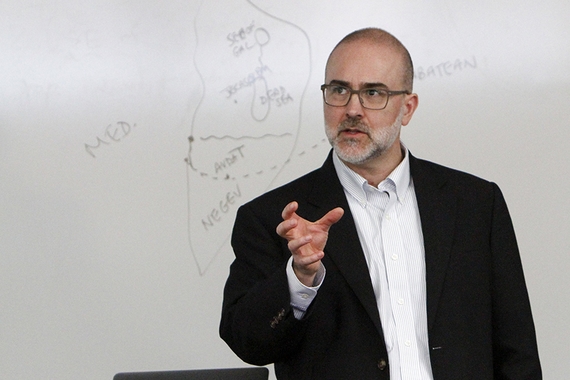
My course has been transformed by these and other similar questions. Instead of performing elite inquiry into ancient elite literature and culture, resulting in elitist classroom discussions where only the previously educated could fully participate, I now have a much more active and inclusive classroom atmosphere. A wider segment of the class feels comfortable asking questions and offering insights. The work they produce (creative essays, comparative essays, and essay exams) is more thoughtful and interesting. And students leave each class, and the course as a whole, questioning at a deeper level. When we talk about relationships between elite and non-elite in Paul, students leave thinking about and questioning similar dynamics in the modern world.
When we talk about depictions of Jesus in the gospels, the questions do not revolve so much around his miracles, his parables, or his powers as the inherently elite Son of God and Messiah. Instead they revolve around his socio-economic status, the power struggles he has with the elite of his time, and the suffering he undergoes as Son of God and Messiah. And of course, this generates questions of the struggles of the powerless and suffering masses at the hands of elite forces in today’s world. The Future of the Past is all about sensitizing ourselves and our students to the injustices inherent in traditional ways of studying antiquity. Teaching from the perspective of the non-elite not only participates in this mission, but it has converted my course into a more active, engaging, and socially transformative experience for me and my students.
 The Future of the Past Lab
Leave a comment